
St. Louis City Recent Arrest Routes
No single list covers every stage of a St. Louis City arrest. SLMPD produces the police-side incident material. The City Division of Corrections runs the Justice Center and its custody locator. Missouri courts keep the later docket and outcome, so each source answers a different question.
The locator offers Active Inmates plus a Released in past 72 hours view. SLMPD posts only selected weekday preliminary releases. Case.net or Municipal Court may later show a filed charge and its outcome, though a charge can change or be dropped along the way.
| Channel | Best use | Limit |
|---|---|---|
| SLMPD releases | Selected incidents and arrests | Not complete |
| CJC active roster | Current custody | Can lag intake |
| 72-hour releases | Recent release | Short window |
| Courts | Docket and disposition | Not live custody |
Why New Arrests May Be Missing
A missing name does not mean no arrest happened. The City locator instructions explain the usual reasons. Someone may still be with SLMPD, waiting at a substation for transport, already released, or listed under a different spelling. Police custody, transport, and roster display are separate steps.
Search the exact first and last name. Try both the active and recent-release views. The City lists two numbers for help: SLMPD Prisoner Processing at 314-241-8339 and the Justice Center at 314-621-5848. The same official instructions page spells out each of these points.
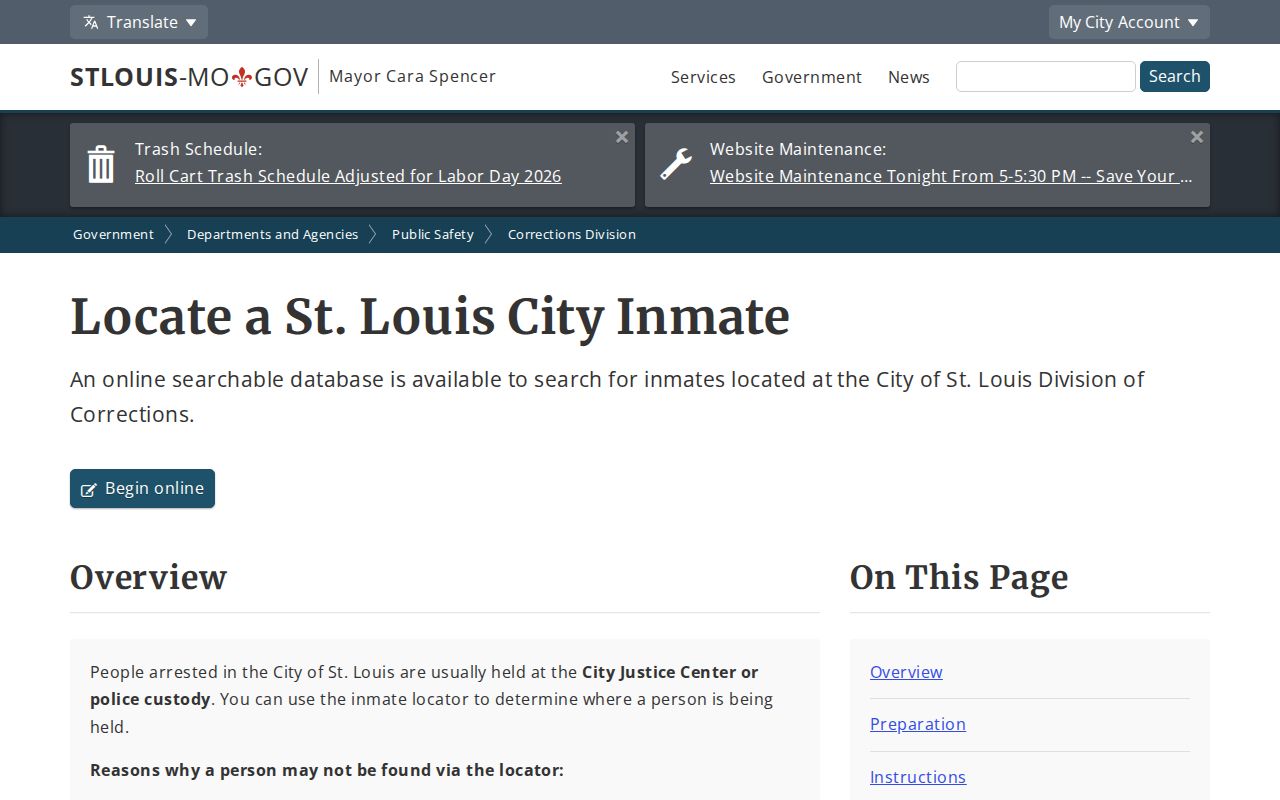
The screen explains the police-to-jail timing gap and exact-name requirement.
Search the St. Louis City Arrest Roster
The public inmate locator handles person-level searches. The City promises name, birth year, race, sex, and facility for each entry. Screens can also show arrest and release times, the charge, a case number, a court date, status, and a photo. Extra fields are features, not guarantees.
| Field | Use |
|---|---|
| Exact name | Required match |
| Active or released | Select custody window |
| Year of birth | Distinguish names |
| Facility | Confirm location |
| Case and court date | Move to docket |
| Photo | Not guaranteed |
Start with Active Inmates. Then repeat the exact name in the 72-hour release view, checking birth year and facility. Save any case number, since the roster shifts as people post bond, move, or leave.
- Enter the exact first and last name.
- Check active and recent-release views.
- Confirm identity and facility.
- Record case number and search time.
- Verify the charge in court.
The City locator search is shown below.
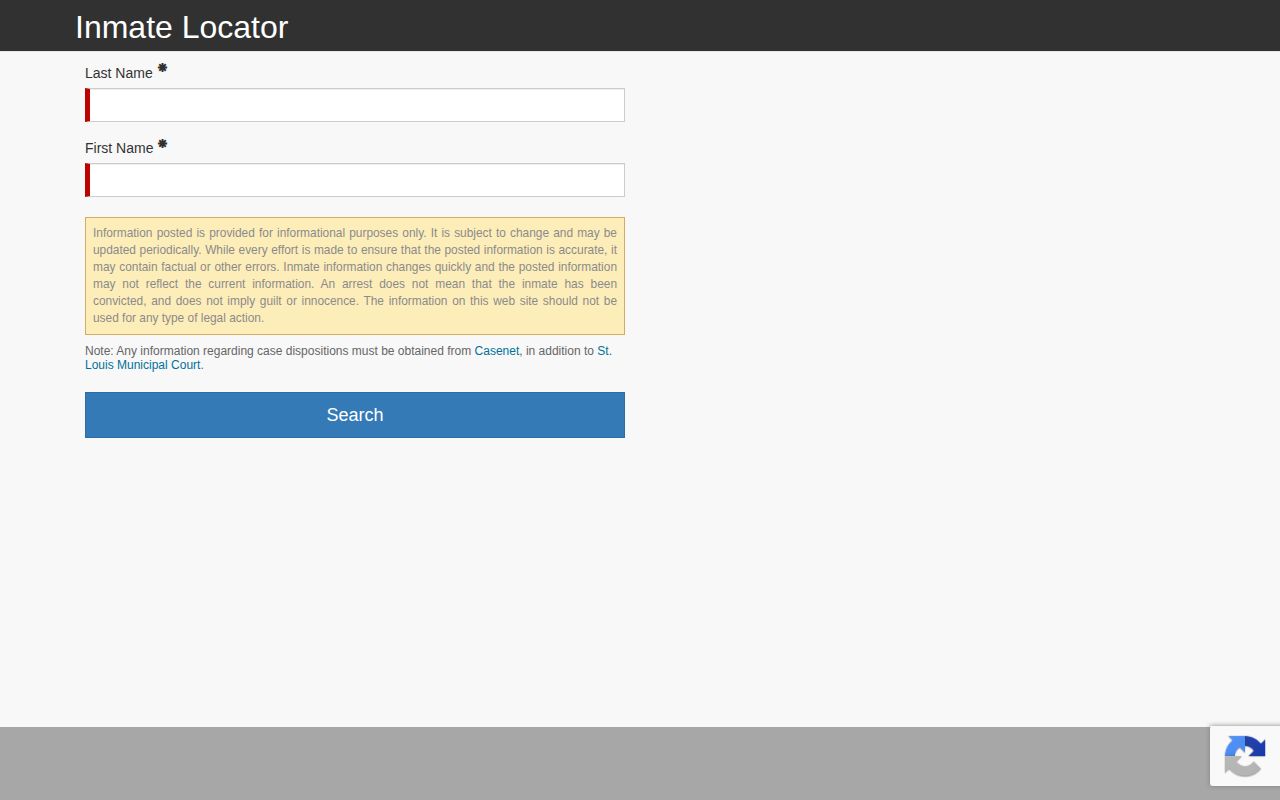
Its two choices define the City’s short public custody window.
Where Released Arrest Entries Go
The 72-hour view is no archive. Once a name rolls off, police reports, booking sheets, court files, and repository records can still exist. Missouri local schedules set a five-year minimum for police and sheriff arrest records and booking sheets. Photos and biometrics normally go to the Highway Patrol Central Repository. Local copies may be reference copies only.
A vanished entry proves nothing. Ask the custodian which retention series applies. Ask whether the file was transferred, closed, expunged, or lawfully destroyed. Historical State Archives collections are not a modern CJC roster.
St. Louis City Arrest News Limits
The SLMPD Crime and Investigations page carries selected weekday preliminary releases, not every booking. Local TV and papers pick stories by news value. "St. Louis" can mean the independent City, the County, or the metro, so verify agency, place, and facility.
Commercial directories rank after official sources. None offers a complete verified City section. Some labels led to County data, empty City results, or stale pages. The official SLMPD release stream page posts each update.
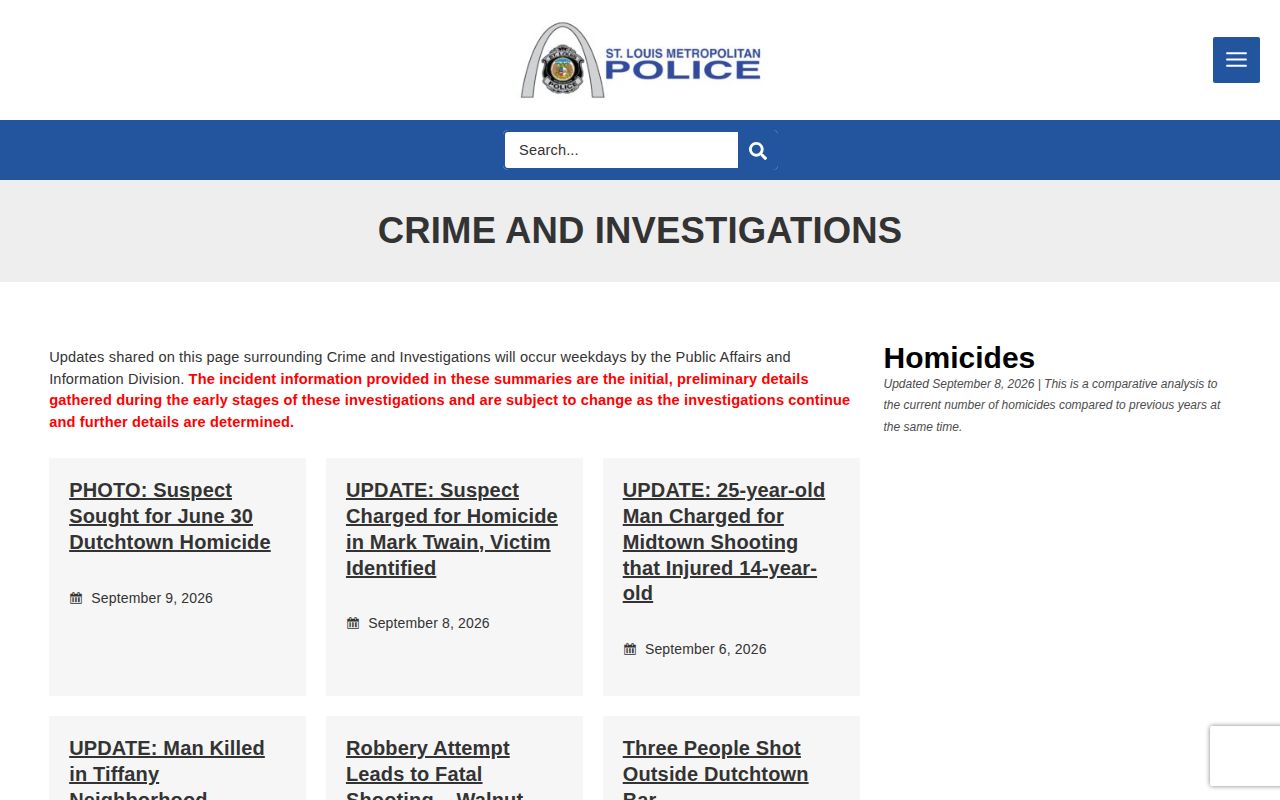
Use it for incident context, then confirm custody and disposition elsewhere.
St. Louis City Arrest Alert Changes
MOVANS is Missouri's VINE-linked alert service. A May 2026 DPS update ended local phone calls and app notices, and required local-jail users to register again. Current local registration works by SMS or email, and a no-result can even mean the jail feed is offline. The DPS update explains the new rules.
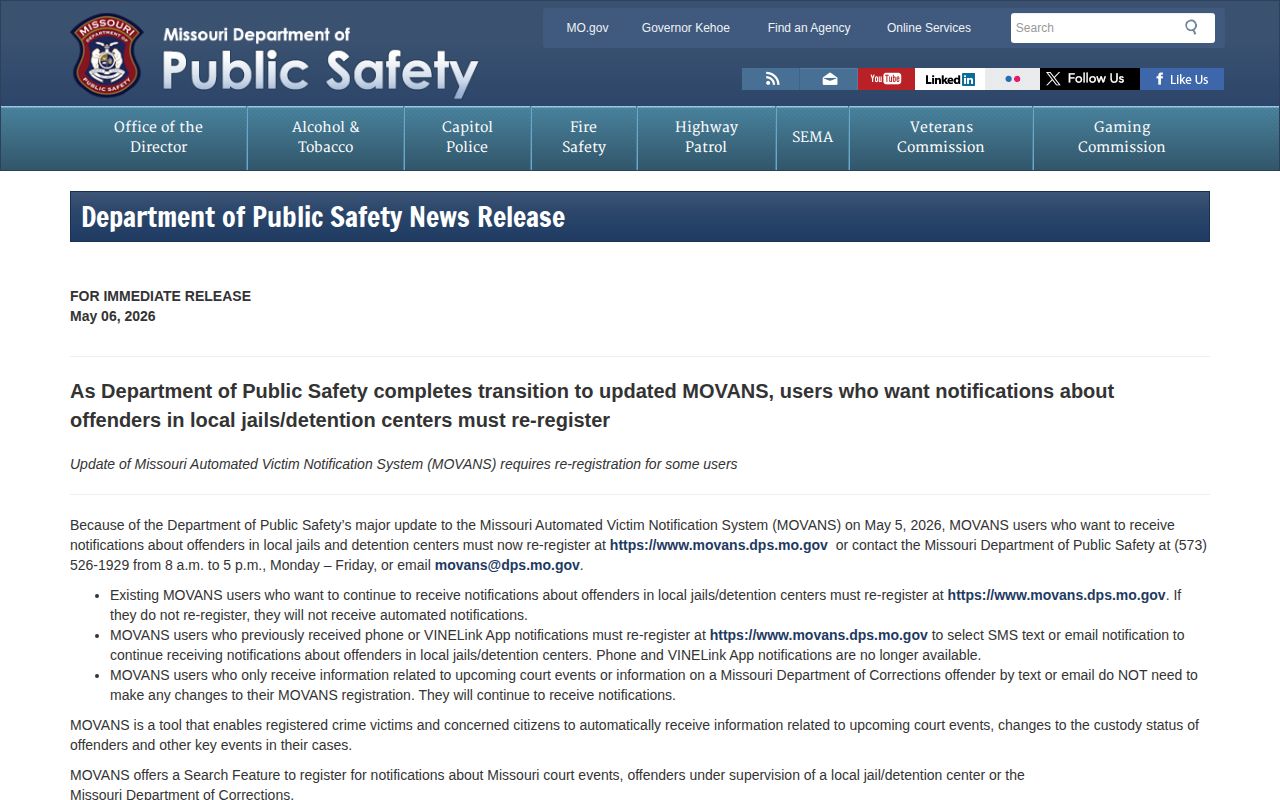
It is the current source for re-registration and text or email alerts.
What a City Arrest Record Shows
Booking is the jail intake step after an arrest. It is not an incident report. The disposition comes later, when a court rules. A record can hold identity, birth year, facility, arrest and release times, charge, case number, court date, bond, status, and a photograph. The public locator shows only part of that file.
Booking number and bond are not promised fields. Search with the exact name, birth year, arrest date, and case number. A loose match can mislead.
Bond Paid Versus Roster Release
The official bond page splits municipal and state routes. It also separates police custody under 24 hours from CJC custody over 24 hours. Bond is a release condition while a case pends. It is not an outcome. The City says release can take hours after payment, while refunds can take months. So "bond posted" and "off the active roster" differ. Confirm court, charge, amount, and custody location.
Arrest Counts Versus Jail Population
Corrections reports give inmate population and average daily population. SLMPD CompStat tracks seven-day, 28-day, and year-to-date trends. Neither is a booking feed. The Justice Center opened in 2002 with capacity for 860, which says nothing about today's population or daily arrest count. The City dashboard serves as the aggregate source.
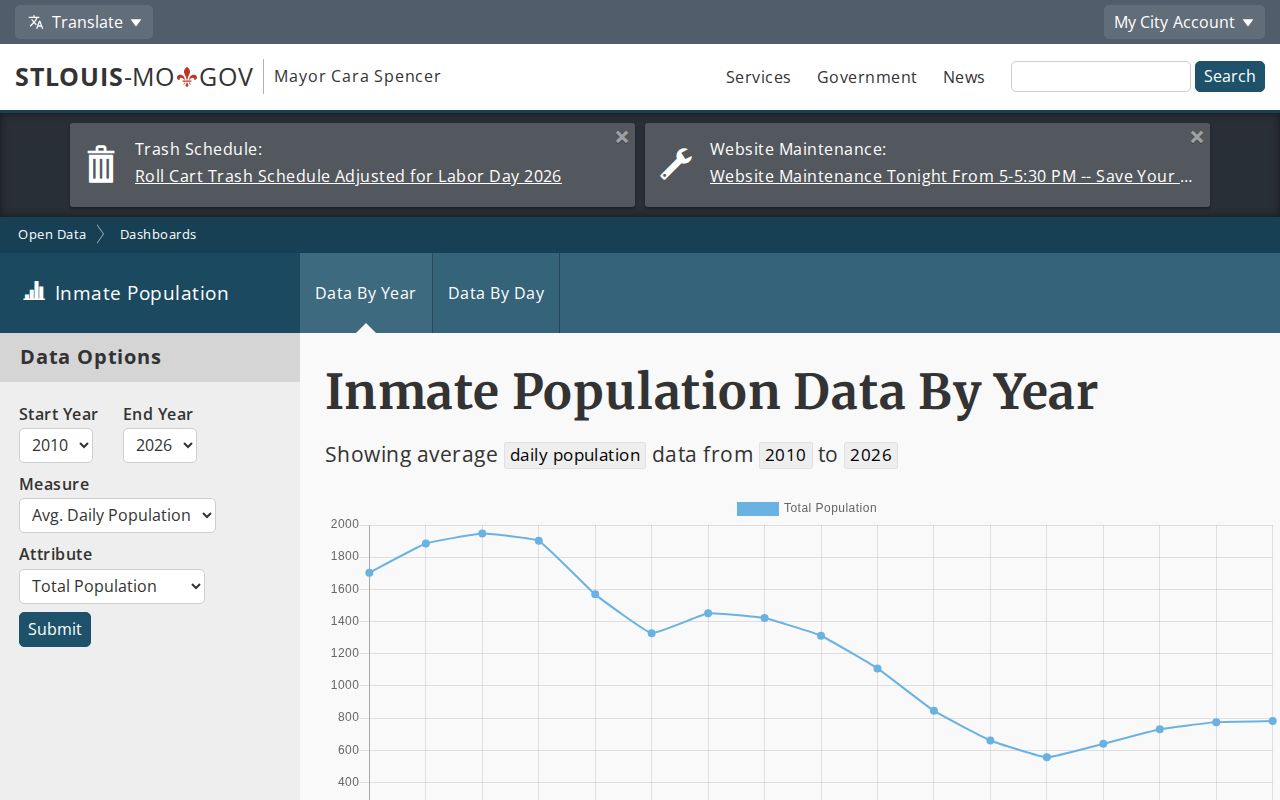
Its totals provide system context, not names or daily bookings.
St. Louis City Mugshots and Arrest Photos
A booking photo is not promised on the public St. Louis City locator. Many entries show a placeholder instead of a mugshot. An arrest photo can still sit inside a police or corrections system. It may never be displayed to the public. Start with the official locator. Then ask Corrections for the best releasable copy, and file a parallel SLMPD request when police may hold the original image.
MODOC Offender Search tracks state prison and supervision, not a fresh City arrest. Its public screens show no photo. Third-party sites often mix up City and County arrests. A publisher cannot lawfully demand payment to correct or remove a booking record.
Request a St. Louis City Arrest Record
File through the GovQA Sunshine process. Send booking questions to Corrections, arrest reports to SLMPD, and include the exact name, dates, case number, and file you want.
- Choose the proper department.
- Identify the person and date.
- Ask for booking, charge, bond, release, and image fields.
- Request the best electronic photo and source system.
- Ask for segregable parts, denial law, and cost estimate.
RSMo 610.023 gives the office three business days. It must act or explain a delay in writing. That deadline does not force release of the record by then. Fees are allowed under RSMo 610.026. SLMPD charges $0.10 per page and $15 per research hour. No set price exists for a booking photo.
SLMPD Records Service Center1915 Olive Street, first floor
St. Louis, Missouri 63103
314-444-5551
After a St. Louis City Arrest
Follow the locator link to Case.net for state charges. Ordinance matters land in St. Louis Municipal Court. Once a roster entry drops off, the docket may still show an amended charge, dismissal, nolle prosequi, suspended imposition of sentence, or conviction.
- Booking
- Jail intake.
- Arraignment
- Early hearing on charges and rights.
- Bond
- Release condition while a case is pending.
- Disposition
- Final case outcome.
- Expungement
- Court process closing eligible records.
Missouri Arrest Records and Removal Law
Missouri law opens most arrest and incident records under RSMo 610.100. Closure or redaction is allowed for active investigations, juveniles, and protected victims. Safety risks and other legal grounds also qualify. RSMo 610.105 permits closure after certain outcomes. Once closed, RSMo 610.120 keeps those records confidential.
RSMo 407.1150 stops a publisher from charging a subject. The law covers removing, correcting, or withholding a booking record. Fix the record at the agency or court source first. Then use free publisher correction policies with proof, and ask for a search-engine cache refresh.
Expungement paths exist under RSMo 610.140. Felonies generally wait three years. Misdemeanors, municipal matters, and qualifying infractions wait one. An arrest-only route usually starts no earlier than 18 months. Exclusions, limits, notice, and filing rules all matter.
St. Louis City Arrest Warrants
The City Sheriff lists no public warrant portal or most-wanted roster. Case.net and the Circuit Clerk can confirm a known case. Anyone possibly facing a warrant should not guess. That person should talk to an attorney or the court instead.
The regional CrimeStoppers list is a dated tips publication spanning City, County, and metro agencies. It is not a warrant database. Never approach anyone on it. Send tips through the official anonymous phone, web, or P3 channels.
St. Louis City Recent Arrest Area
St. Louis is an independent city. It holds no incorporated towns the way a Missouri county would, and St. Louis County municipalities sit in a different jurisdiction. City of St. Louis Recent Arrests follows the SLMPD, Justice Center, and court chain. Confirm all three before drawing any conclusion.
St. Louis City Custody Boundaries
MODOC Offender Search covers state prison, probation, and parole only. It is not the Justice Center roster. A fresh local arrest may not appear there, and the public interface shows no photo. BOP lists federal prisoners from 1982 onward but publishes no mugshots. ICE and USMS run separate systems. A federal detainee can sit in a local jail without the usual City booking path. Always check which agency holds legal custody.
The St. Louis City Sheriff plays a narrower part. It handles court security, prisoner transport, and service of process for the 22nd Judicial Circuit. It does not run the Justice Center roster. For ordinary booking questions, Corrections, SLMPD Prisoner Processing, and SLMPD Records are the right contacts.
St. Louis City Booking Search Gaps
The City explains why a search can fail. A new arrestee may still be with SLMPD on the Justice Center first floor or at a substation awaiting transport. Another person may get released before the entry posts. Exact-name matching can hide a record when spelling, spacing, or a middle name differs. Check both views, note the search time, and call the contact matching that custody stage.
A later no-result means something different. The released view keeps only 72 hours. It cannot answer a broad historical question, even when a police release, arrest report, booking sheet, and court docket still exist after the roster entry rolls off.
St. Louis City Booking Facility
The Justice Center opened in 2002. Its listed capacity is 860. The City Department of Public Safety, Division of Corrections, runs it, and the population mixes people held before trial with sentenced people. So current population is never a count of recent bookings.
Capacity is not live occupancy either. The Corrections dashboard gives aggregate figures. The locator answers person-level custody questions. Neither tool produces a daily arrest total, and SLMPD crime statistics measure reported trends rather than jail intake.
St. Louis City Arrest Release Timing
St. Louis City splits custody questions in two. Police custody under 24 hours follows one bond route. Justice Center custody past that mark follows another, and municipal and state cases can carry different payment paths. Ask where the person is held and which court controls the case first. The Justice Center, Prisoner Processing, and the court each answer a distinct question.
Paying a bond starts release processing. It does not clear the active entry at once. The City itself warns that release can take several hours after bond posts. Refunds can take months. A person may stay listed while staff finish the steps. Bond never settles the charge; the case moves forward until a disposition.
St. Louis City Custody Data Context
The Corrections dashboard reports inmate population and average daily population. SLMPD's CompStat compares seven-day, 28-day, and year-to-date measures, and its weekly reports stay preliminary. These sources answer system-level questions only. They never name who was booked. An arrest is a police event. A booking is jail intake. Daily population counts everyone held after releases and transfers, including some sentenced inmates. One figure cannot prove a change in another. A named case still needs the locator and the court docket.
St. Louis City Booking Photo Access
The public locator guarantees identity and facility fields. It does not guarantee a booking photo, and some results display an "Inmate Photo Not Available" placeholder. SLMPD keeps booking images in a restricted recognition environment. So an official photo may still exist. Ask Corrections for the original electronic booking photograph or highest-quality releasable copy, if one is kept. Ask SLMPD whether it made or holds an image. Then request the source system and the legal basis for withholding.
St. Louis City Arrest Case Systems
State criminal matters go through the 22nd Judicial Circuit. Case.net lets anyone check them. City ordinance matters belong to Municipal Court instead. The locator points to both systems because a jail entry is not the final court record.
Search by case number first. Then compare the name and dates, since a docket may show a changed charge, dismissal, nolle prosequi, not-guilty result, suspended imposition of sentence, or conviction, so pair it with any old booking claim. If nothing matches, call the right clerk instead of forcing a similar name.
St. Louis City Record Access Limits
A roster is not an all-person archive. Missouri law allows closure or redaction for active investigations, protected victims, confidential sources, safety needs, juvenile status, and certain outcomes. Closed records stay confidential. Closure does not destroy them. Operational gaps are a different problem, since someone can still be in police custody, waiting for transport, already released, or listed under another spelling. A focused Sunshine request lets the custodian say whether a record exists and name the legal ground for anything withheld.
St. Louis City Arrest Record Retention
Local retention schedules place arrest logs, files, registers, fingerprints, and booking sheets in series. Those series carry a five-year minimum. Destruction must be secure. An item tied to an investigative file can follow a longer rule, pending litigation stops ordinary destruction, and an office may keep records past the minimum.
Related items run on other clocks. Jail activity logs carry a five-year minimum, while booking surveillance starts with a 30-day evaluation and extracted evidence stays through the proceedings. Warrants stay until served, expired, vacated, or recalled. Expungement orders may stay with a file to explain redaction, so ask for the precise series that covers your item.
St. Louis City Record Correction
Start with the office that created the record. Send a wrong identity, disposition, sealing order, or expungement order with the exact record reference and court proof. Several agencies may hold copies. Each one needs separate notice. No search engine can change a government file.
After the origin is fixed, free publisher processes may address copied pages under stated policies, with free grounds covering error, wrong person, juvenile status, dismissal, sealing, expungement, identity theft, or death. No current City feed appears on those sites. Missouri law bars conditional payment demands, and an outdated-content request can refresh stale search snippets.
St. Louis City Booking Request Costs
The Sunshine Law gives a custodian until the third business day to act. Or the office must explain the delay. It also has to give the earliest completion date. That deadline does not promise delivery of a complex image request, so a written request separates response timing from production time.
RSMo 610.026 allows costs for copies, research, and visual items. SLMPD's examples include ten cents per page and research prorated at fifteen dollars per hour, so a simple report often costs under five dollars. The City lists no fixed booking-photo tariff. Ask for an estimate and confirm current payment methods.
St. Louis City Warrant Source Limits
The City Sheriff's role centers on court security, transport, process service, and related work. The office posts no Citywide warrant search. There is no Sheriff most-wanted page either. Skip County pages and commercial stand-ins.
Regional CrimeStoppers publishes dated wanted-subject notices spanning City, County, and metro agencies, with rewards up to $2,000 and anonymity required through phone, web, or P3. Never approach a subject. Anyone who may be affected by a warrant should resolve it through an attorney or the court.
St. Louis City Booking Archive Boundaries
Older St. Louis City arrest records live in a few very different places. The Missouri State Archives keeps its St. Louis branch open by appointment. Its Circuit Court holdings span 1804 to 1875. Those volumes are history, though. Nobody will find a modern Justice Center booking photo there. The state penitentiary database is a separate animal, covering prison records and photographs from 1836 to 1931, and it says nothing about City custody. For an older booking, start with Corrections or SLMPD, then try the courts or the Highway Patrol repository, and reach for the archives only when the dates fit.