
St. Louis Daily Arrest Report Window
St. Louis City posts no official page listing every booking from the last 24 or 48 hours; the nearest source is the City of St. Louis inmate locator. Treat it as a custody tool. It shows current inmates and very recent releases, not a chronological daily arrest log. The form offers two choices. One is Active Inmates; the other is Released in past 72 hours.
That distinction shapes any same-day check. An arrest starts as a police event. The person may sit at a substation first. They might then pass through SLMPD Prisoner Processing, wait for transport, and enter the Justice Center before the locator shows them, with bond or release sometimes following fast. The City names no fixed refresh hour and makes no promise that every arrest appears by a set time.
The Justice Center answers to the City Department of Public Safety, Division of Corrections. It is not a county sheriff jail. The independent city still performs county-equivalent functions. Corrections maintains the main local custody channel, while the Sheriff's Office handles court security and transport. That split matters. Choose the right phone number or records custodian.
How to Check St. Louis Arrests Today
Start with the City's official instructions, then work the custody channels in order. Spelling counts. The locator takes an exact first and last name, not a fuzzy match.
- Open the City inmate locator instructions and follow the link to the live search.
- Enter the exact first and last name. Start with Active Inmates for a person thought to be at the Justice Center.
- Review the facility, status, arrest time, charge, case number, and court fields if the current interface displays them.
- If there is no active match, select Released in past 72 hours and repeat the exact-name search.
- For a very fresh arrest, call SLMPD Prisoner Processing at 314-241-8339 or the City Justice Center at 314-621-5848.
- If the event is older or the online record rolled off, request the underlying record from Corrections or SLMPD Records.
The St. Louis City recent-arrests hub traces the wider record chain, including court and records-request routes. Use it for the report, not just custody confirmation. Those routes are covered there.
Fields in the St. Louis Arrest Locator
The official instructions promise a narrow set of fields. Identity and custody details sit at the core. The live screen can show more, and those extras may shift because the City updates the system periodically.
| Field | How to read it |
|---|---|
| Name and year of birth | Use these together to distinguish people with similar names. |
| Race, sex, and facility | These are among the fields named in the official locator instructions. |
| Arrest and release time | Observed interface fields that help place the custody event, but are not a guaranteed daily-feed history. |
| Charge and case number | The charge is a booking-stage charge. The case number can lead to the later court record. |
| Next court date and status | Observed fields that may help with follow-up; verify disposition through the court. |
| Photo area | A photo is not promised. The inspected result displayed an Inmate Photo Not Available placeholder. |
Bond has its own separate instructions. It may not appear in every locator result. A booking number is not promised either. Ask the records custodian whether a booking or master number exists for the arrest.
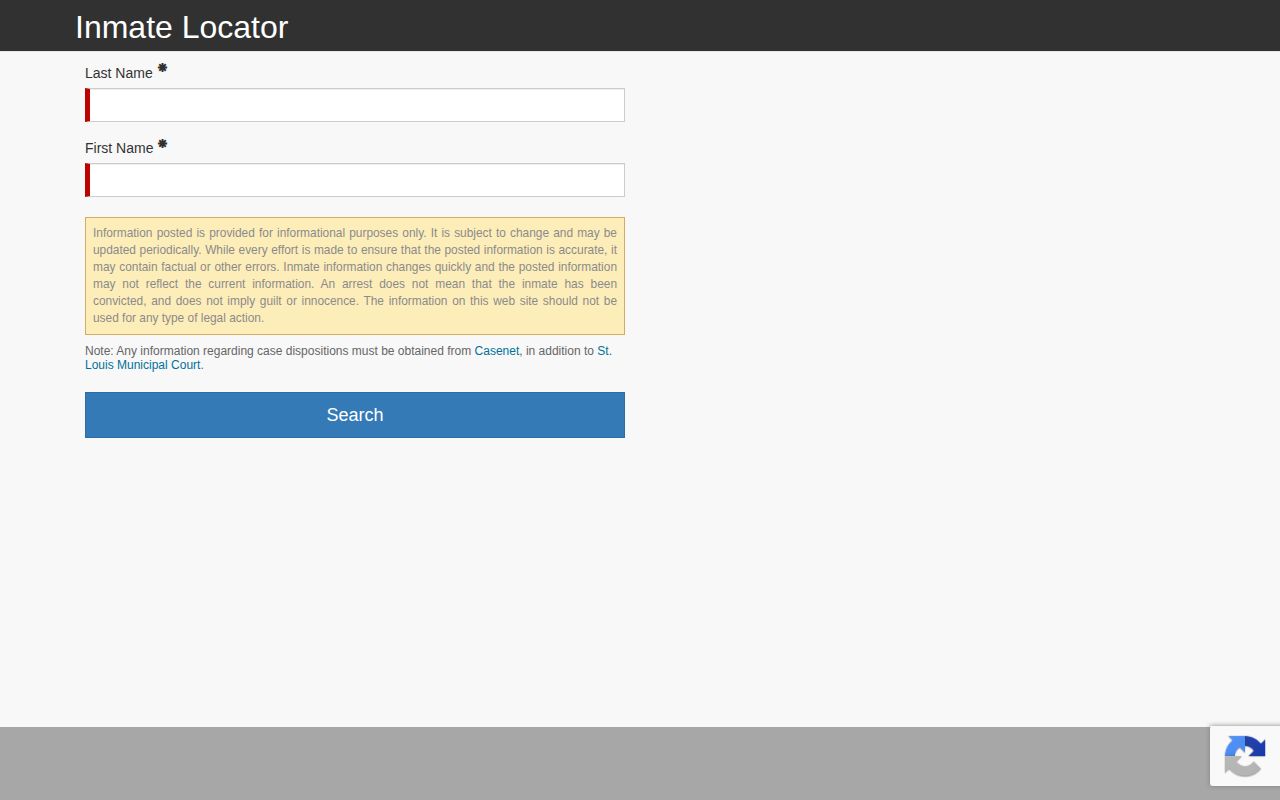
Some results point past custody. A case number or next court date links the booking stage to later proceedings. For outcomes, the City itself points to Missouri Case.net and St. Louis Municipal Court. Treat status labels as written. The public St. Louis inmate locator shows the neutral search screen used for same-day checks.
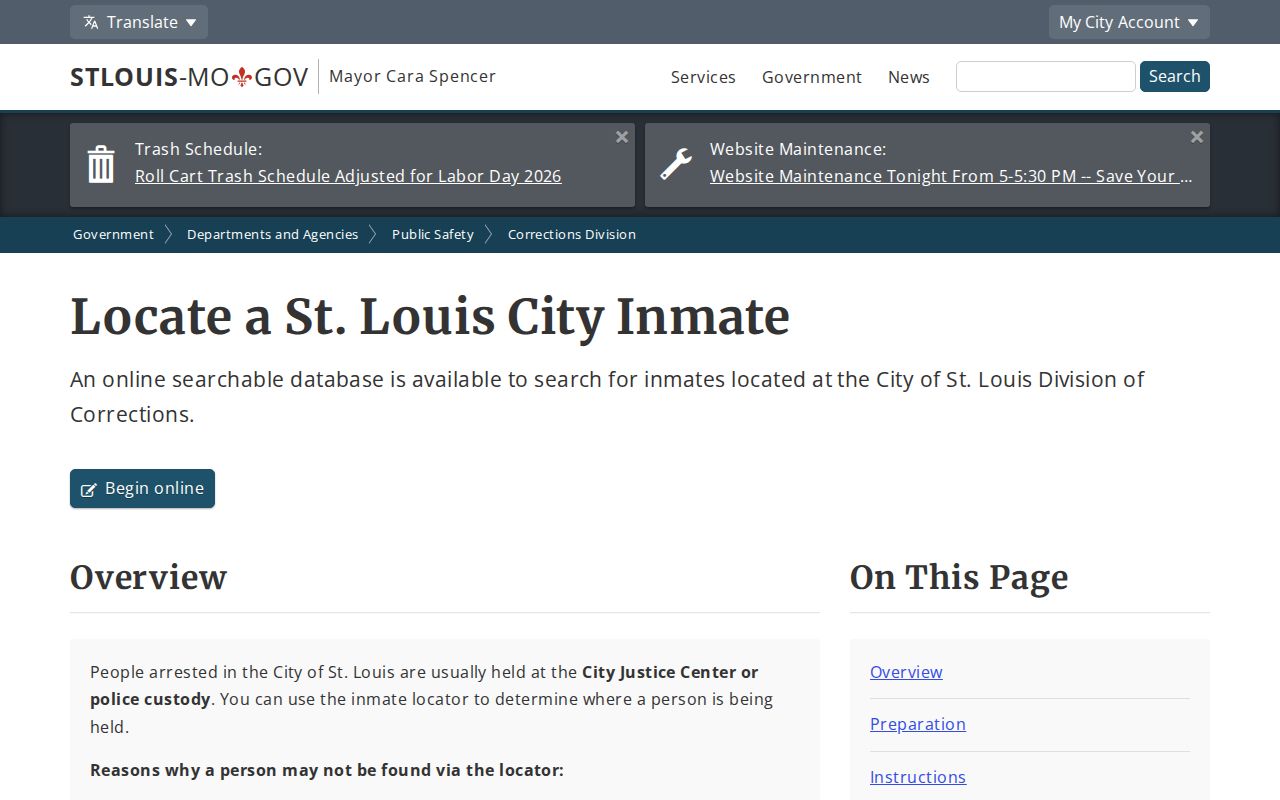
The City's official locator instructions explain exact-name searching and the common reasons someone may not appear. No gallery of people appears. It names the correct City custody tool.
This official page supplies the context needed to interpret the separate live search interface.
When a Fresh St. Louis Arrest Is Missing
A blank result does not prove no arrest happened, and the City lists several reasons why. They might still be on the first floor with police. They could sit at a substation waiting for transport. Release may have already happened. Spelling that does not match the search also hides people, and juvenile, protected, or sealed material stays out of the public view.
Run the locator first. Then phone the agency holding the person. SLMPD Prisoner Processing is the better contact during police custody. The Justice Center takes over after jail admission. For a record rather than a custody check, SLMPD Records lists 314-444-5541, and the City Sunshine process can route a request to the Division of Corrections.
Note: Record the source and the time checked because a same-day custody result can change after transport, bond, or release.
St. Louis Arrest Charges and Court Results
A locator charge shows what police recorded at the booking or custody stage. It can change later. Courts may amend, reduce, or dismiss it. Custody status and court outcome are separate records. For disposition details, the City points users to Missouri Case.net and St. Louis Municipal Court.
Why St. Louis Arrests Lag Online
Getting from a street arrest to a web result takes several handoffs. SLMPD may hold a person during processing first. The Division of Corrections then accepts that person at the Justice Center. Transport, identity checks, data entry, bond work, and court action all shape the timing. A quick release can mean an entry never shows in the public locator at all.
No City source promises a posting hour. Nothing sets a weekend schedule or a maximum intake-to-web delay either. A periodic system should not be mistaken for a live dispatch log, so time-sensitive questions are safer with the locator plus the right phone contact.
Custody type matters too. Someone still with SLMPD is in police processing, not yet a confirmed Justice Center inmate. An active CJC result means jail custody. The Released in past 72 hours view means the person has left the active roster, though the arrest and booking records may still exist behind it, and a later Missouri Department of Corrections entry reflects state custody after sentencing rather than the same-day City booking window.
These stages can overlap briefly in public search results. Each system runs on its own purpose and cadence. When two sources disagree, ask the agency that controls the current stage, and note the time of the answer. For immediate custody, that may mean Prisoner Processing or the Justice Center. For the final result, go to the court docket.
No St. Louis Jail Arrest App
The sheriff route is a dead end here. The City Justice Center offers no booking app. The St. Louis City Sheriff's Office serves the 22nd Judicial Circuit with court security, prisoner transport, and service of process. It does not run the City jail roster. That job belongs to the Department of Public Safety's Division of Corrections, which operates the Justice Center custody system. So skip any sheriff-branded tool or St. Louis County app. The working chain stays the same: the CJC search, Prisoner Processing, the Justice Center phone, and a formal records request when the online answer falls short.
Keep any formal request narrow. Name the person, the arrest date or date range, the arresting agency, and any known case number. Ask the Division of Corrections for the booking or master number, intake date and time, recorded charges, and release date and type. If some fields are withheld, request every segregable portion. SLMPD holds the arrest or incident report separately. Its Records Service Center sits at 1915 Olive Street and lists 314-444-5541 for record checks. Both the City and SLMPD handle formal requests through a GovQA-based Sunshine process.
A request is slow. It will not settle an urgent custody question tonight. But it is the durable route once the short public window closes or a full booking file is needed. Missouri arrest-report law permits closure, withholding, or redaction in defined situations. Juvenile records, protected victims, active investigative material, sealed records, and expunged matters all demand care. When something is withheld, ask for the specific legal basis. Then request any part that can still be released. That keeps the file honest without stalling the search.